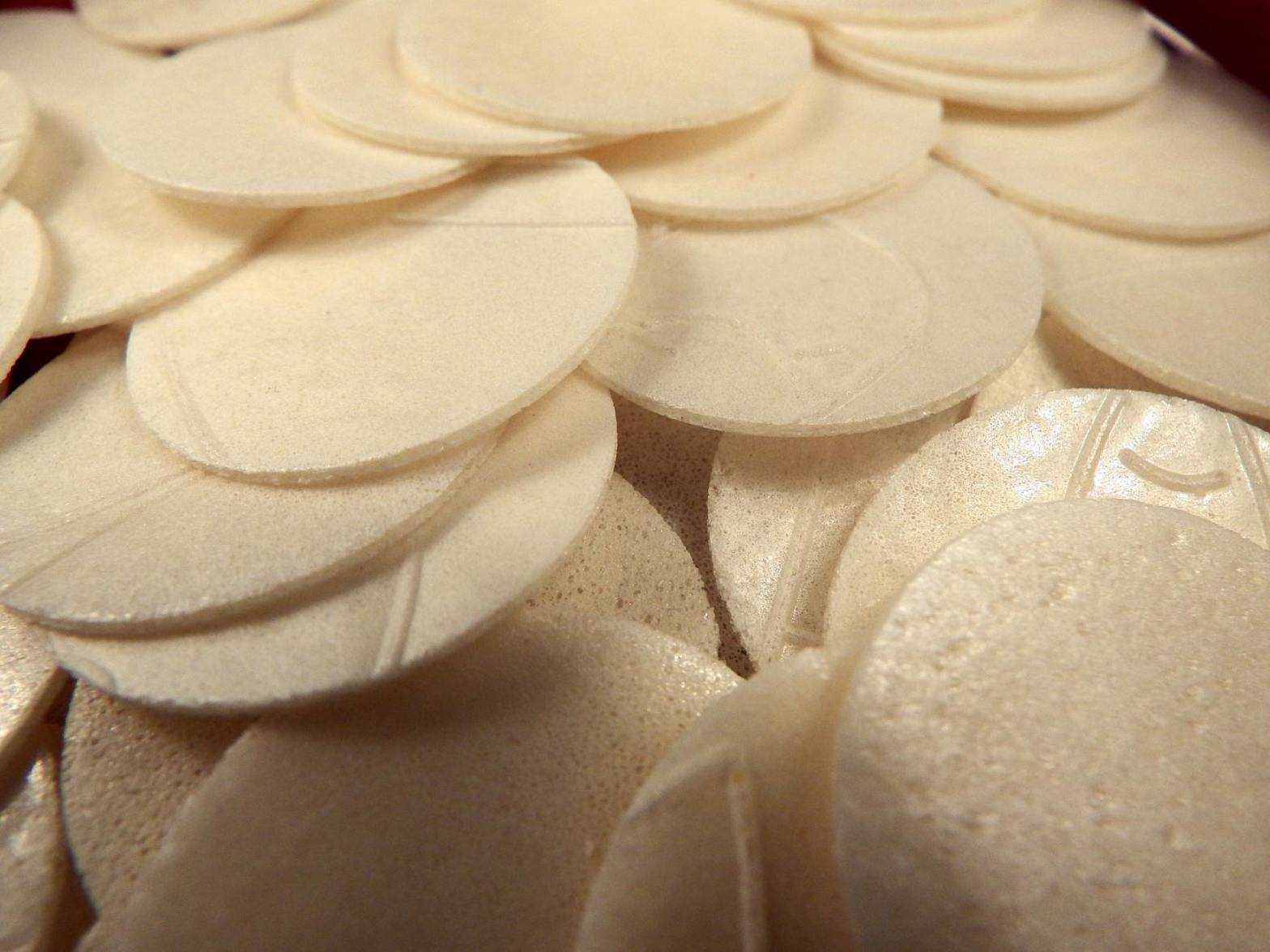
Discussion Article: First, Communion by CHRIS EBBERWEIN

Before Discussion Notes:
- Whether the topic is liturgy, Vatican II, social justice, or moral fidelity, this hand-grenade-style of communication—toss out the sarcasm and run—causes me to wonder how Catholics will overcome this divisive time.
- The Church (and the human heart for that matter) is always big enough for piety and for zeal, for work and for worship; though at a given moment, an individual’s faith might magnify one element of Christianity more than another.
- Ministering to the suffering is a way to love God. Reverent liturgy and humble obedience are ways to love God. If two Catholics journey toward Christ from differing starting points, does it aid either person—or the larger Church—to dismiss the other’s perspective?
- To avoid judgment, learning to “live and let live” seems a safe choice. Such tolerance might suffice as step one for the intolerant, but it falls far short of Christ’s example of speaking the truth in love. Whereas judging reveals a narrow focus on the splinter in another’s eye (Mt 7:3).
- When rooted in mutual trust, correcting another’s error is a gift of sorts, and the Church would be stronger if her children could give and receive correction in the way Christ taught.
- He expects the same of His followers—that we would take seriously the mission to draw others to Him.
- In truth, scripture resounds with messages to invite, heal, serve, and preach, so that every person might adhere to the Body of Christ.
- Facing beliefs contrary to Jesus’ teachings, the role of a Christian remains the same—to draw his opponent closer to Christ.
- [Humble] curiosity could lead to relationship—a more hopeful starting point for conversion than an accusing finger.
- When focused on shortcomings, one might overlook a valuable contribution the other makes to the faith.
- By noticing the complementary nature of such roles, the Church lives out Paul’s teaching that “the eye cannot say to the hand, ‘I do not need you’” (1 Cor 12:21).
- If we aim to appreciate the gifts another uses in service of God, rather than training our eyes on shortcomings, the Church might experience another kind of appreciation—an increase in value, each sinner growing in virtue by way of relationship to another.
- In curious dialogue, however, each might find attractive the gifts found in the other, providing a much greater chance for true communion, and perhaps even growth in virtue.
Discussion Questions:
- Do I find myself judging others in a way that undermines my ability to be in communion with them?
- How can I help to draw those Catholics and Christians around me closer to Christ with my prayers, actions, and deeds?
- How can I correct another’s error humbly? How do I receive correction?
( The author of this featured article, Chris Ebberwein, is the uncle of one of FtJ’s discussion leaders. He is also the author of The Cana Rosary: A Couple’s Prayer.)
👙We’ll have splash pads out for the kids so bring bathing suits, towels, and extra change of clothes!
🙏 The Savannah MI Village is slowly growing. If you’re interested in joining, please let us know! It’s monthly prayer meetings (in-person or online) to pray for lost souls and is the prayer sector of FtJ. Savannah MI Village Feature here -> https://www.facebook.com/share/p/xCbB5gdM6fnLpVVs/
👰♀️ The next Wives Workshop on ‘Community’ is later this month (July 27th, 2024)! It’s free and a quarterly event where we take a deeper look into the basics of being a Catholic mom & wife. More info & sign up: www.veiledingoodness.com
 Farm to Jesus